- Role
- UX/UI Designer, Web Developer
- Responsibilities
- UX/UI design, front-end development, content strategy, visual direction, responsive development
- Technologies
- Astro, React Islands, Tailwind CSS, GSAP
- Dates
- May 2026
Heading to my universe...David Langarica © 2026
A custom website for an energy consulting firm that needed to feel as strategic as the work behind it.
Future Energy Strategies helps large energy users make better decisions in volatile markets through timing, risk visibility, and cost clarity.
Future Energy Strategies (FES) needed more than a visual refresh. The previous digital presence no longer reflected the ambition of the business, and the new website had to make a highly technical service feel clear, credible, and distinctive from the first interaction.
FES works with large energy users navigating volatile markets, complex usage patterns, supplier decisions, hidden charges, and timing risk. The challenge was to translate that expertise into a focused digital experience without turning the site into an industry document.
The work combined UX/UI design, front-end development, content strategy, visual direction, and responsive development, with one central goal: help the right decision-maker understand the problem, trust the expertise, and book a conversation.
FES came into the project with a clear need for a stronger digital presence. The existing site felt outdated and too limited for the direction the company wanted to move toward. The goal was not to make a typical energy consulting website look nicer. It was to create a more strategic, modern, and memorable experience that could represent the future of the brand.
That meant the website had to do two things at once: communicate serious expertise and avoid looking like every other technical consulting site in the industry.
The main challenge was not that FES had too little to show about them, the whole opposite.
The raw material covered deregulation, Customer Choice, wholesale markets, hedging, load factor, capacity charges, procurement timing, futures, historical trends, automated platforms, hidden costs, and market dashboards.
All of that mattered, but it could not be placed directly on the page. For a business owner or executive, the site needed to answer a much simpler question: why should I question my current energy strategy?
The work became an exercise in reduction. What should be simplified? What should be kept? What should be removed? And what needed to become clear before the user would feel ready to act?
The audience was not everyone, but it also could not be limited too narrowly.
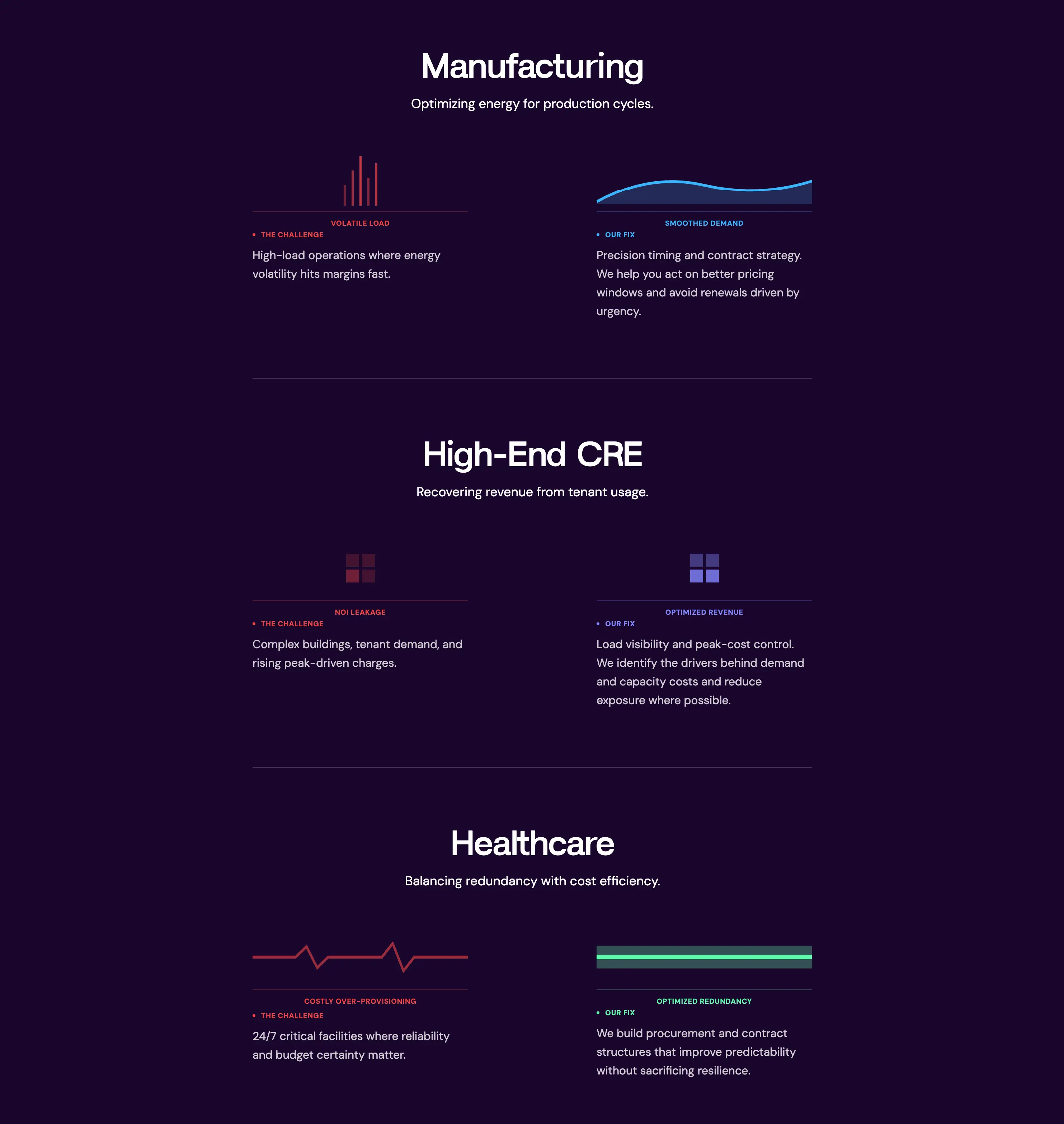
FES had strong experience with manufacturing, but the website needed to speak to a broader group of large energy users with complex consumption patterns, high operational risk, and enough energy spend for strategy to matter.
That audience could include manufacturers, healthcare facilities, commercial properties, high-rise buildings, and other large operations where timing, usage patterns, capacity charges, and supplier decisions can materially affect the bottom line. This helped shape the messaging. The site needed to feel specific enough to be credible, but flexible enough to avoid boxing the brand into a single sector.
One of the most important strategic decisions was to avoid positioning FES as another broker promising the lowest rate. The value of FES is not simply cheap energy. The value is timing, risk visibility, transparency, market awareness, and informed decision-making.
The website reframes energy decisions as a strategy problem: when to act, what to question, which costs may be hidden, and how market timing can affect the bottom line.
That gave the site a sharper point of view. Instead of relying on generic consulting language, the experience shows that FES understands the questions large energy users should be asking before they make a decision.
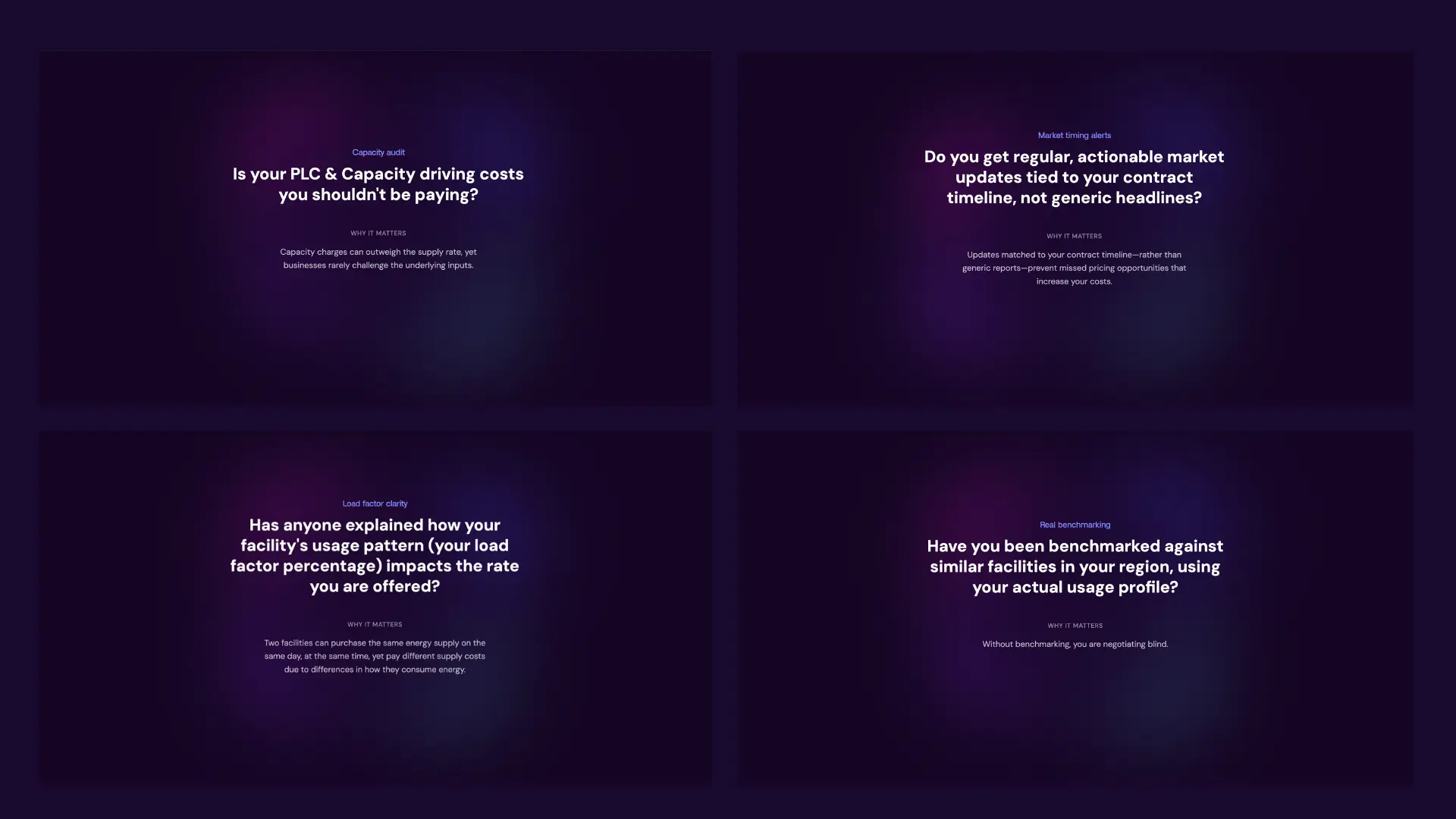
The content strategy focused on translating dense energy concepts into short, decision-oriented messages.
Each section needed to make three things clear: what the issue is, why it matters, and why FES is positioned to help. Instead of explaining every technical detail upfront, the site moves users from a broad market problem into focused service ideas such as market timing, bill forensics, procurement strategy, hidden cost drivers, and a free consultation.
The goal was not to oversimplify the business. The goal was to make the complexity approachable enough for the right person to take action.
Visually, the site needed to suggest energy without relying on the obvious clichés of the industry. That meant avoiding generic elements, power grids, stock photos, dashboards, and purely corporate layouts. FES needed something more ownable, more modern, and more emotionally distinctive.
The final direction uses a purple-forward palette, abstract motion, particle-based compositions, contrast, and 3D-inspired visual moments to evoke foresight, market movement, and future strategy.
The interactive layer was intentionally controlled. The goal was not to build a heavy technical spectacle. It was to create enough movement and depth to make the brand feel alive while keeping the experience focused and easy to understand.
Motion was used to support perception, not distract from the message. That restraint was important for a serious service business where clarity, performance, and trust matter more than visual noise.
The CTA evolved from a generic contact action into a reason to act.
The strongest conversion idea came from the Energy Truth and Hidden Truths direction: give users a reason to wonder what their current broker may not be showing them.
Instead of only asking people to book a call, the site creates curiosity around hidden costs, overlooked questions, and opportunities that may be missed without deeper analysis.
The point was simple: do not just ask users to schedule a consultation. Give them a reason to believe the consultation could reveal something they are currently missing.
I delivered a custom website for Future Energy Strategies with a sharper content structure, responsive layouts, a distinctive visual direction, motion-led brand moments, and a conversion path centered on booking a consultation.
The final site positions FES around market timing, cost visibility, risk awareness, and strategic decision-making, not generic energy consulting language.
The result is a digital presence that feels more aligned with the company’s expertise, ambition, and future-facing positioning.
This project reinforced that serious industries do not need boring websites. They need sharper ways to be understood.
The hardest part was not making the site look more complex. It was reducing the noise enough for the real value of FES to come through.
A strong website for a complex service should not explain everything at once. It should help the right person understand the stakes, trust the expertise, and take the next step with confidence.
David Langarica is an exceptional web engineer and a true creative talent. His ability to combine technical precision with artistic vision is rare, and the final website exceeded every expectation.
Heidi B. Rodino, CEO, Future Energy Strategies
